WSU NSFAS Application 2027: How to Apply, Eligibility, and What You Get


 June 9, 2026 7:27 pm
You got into WSU, or you are applying right now. But tuition fees, accommodation, and living costs are a real barrier. That is exactly what NSFAS exists to solve.
The WSU NSFAS application connects eligible South African students at Walter Sisulu University with government-funded financial support that covers tuition, accommodation, food, books, and transport. It is not a loan for most students; it is a bursary, meaning you do not repay it as long as you pass your modules and complete your studies.
But the application process has strict deadlines, specific document requirements, and steps that many first-time applicants get wrong. Missing one step can delay your funding for an entire academic year.
This guide is based on official NSFAS and Walter Sisulu University information and is regularly updated for accuracy. Everything here reflects the 2026 academic year cycle.
Quick Answer:
The WSU NSFAS application is the process through which Walter Sisulu University students apply for government funding via the myNSFAS portal at www.nsfas.org.za. To qualify, you must be a South African citizen studying at a public institution with a household income below R350,000 per year. Applications for the 2027 academic year opened in September 2026 and closed on 15 November 2026.
What Is the WSU NSFAS Application?
NSFAS, the National Student Financial Aid Scheme, is a government-funded bursary programme administered under the Department of Higher Education and Training (DHET). It was created to give South African students from low-income households access to tertiary education that would otherwise be out of reach financially.
At Walter Sisulu University, NSFAS funding covers:
NSFAS does not fund studies at private institutions. WSU, as a public comprehensive university, is fully covered under the NSFAS funding framework.
One important clarification most guides skip: NSFAS is only available for first undergraduate qualifications. If you already hold a degree and want to study a second one, you do not qualify. This catches many returning students off guard.
Who Qualifies for WSU NSFAS Funding?
Before applying, check whether you meet every one of these requirements:
Eligibility Criterion | Requirement |
|---|---|
Citizenship | South African citizen with a valid ID |
Institution | Applying to or enrolled at WSU or another public university/TVET college |
Household Income | Combined annual income of R350,000 or less |
Disability | If disabled, the household income threshold increases to R600,000 |
SASSA Recipients | Automatically eligible, no income verification needed |
Qualification Level | First undergraduate qualification only |
Academic Standing | Must maintain satisfactory academic progress to keep funding |
The R350,000 Household Income Rule — What It Actually Means
This is the single most misunderstood part of the WSU NSFAS application. “Household income” does not mean just your parents’ salaries. It means the combined gross income of everyone living in your household, including both parents or guardians, a working spouse if you are married, and any other income-earning adults in the same home.
If your household earns R351,000 per year, even by R1,000, you fall outside the standard threshold. The only exception is students with disabilities, where the limit rises to R600,000.
SASSA grant recipients’ households receiving a social grant are automatically considered eligible without the income verification process. This significantly speeds up the application for those students.
WSU NSFAS Application Dates 2027
Event | Date |
|---|---|
NSFAS Applications Open | 17 September 2026 |
NSFAS Application Closing Date | 15 November 2026 |
Applications Processing Period | October–December 2026 |
Provisional Funding Decisions Released | From 15 December 2026 |
WSU Registration Opens | 7 January 2027 |
First Allowances Released | From February 2027 |
NSFAS does not accept late applications. If you missed the 15 November 2026 deadline, you will need to wait for the next application cycle. There is no exception process for the main application window.
The myNSFAS portal tends to experience high traffic near the closing date. Submit your application at least two weeks before the deadline to avoid server delays and last-minute upload failures.
Documents You Need Before Applying
Getting your documents ready before opening the portal saves time and prevents errors. Every document must be a certified copy — certified within the last three months by a commissioner of oaths.
For all applicants:
For SASSA recipients:
For students with disabilities:
Common document mistake: Many applicants upload low-resolution or blurry phone photos of their documents. NSFAS flags these during verification, which delays processing. Use a scanner app on your phone, such as Microsoft Lens or Adobe Scan, which are free and produce clear PDFs.
How to Apply for WSU NSFAS — Step by Step
Step 1: Create a myNSFAS Account
Go to the official NSFAS website: www.nsfas.org.za
Click “myNSFAS” at the top right corner of the page. Select “Register” and fill in your details: full name, South African ID number, cellphone number, and email address. Tick the consent box and click Submit.
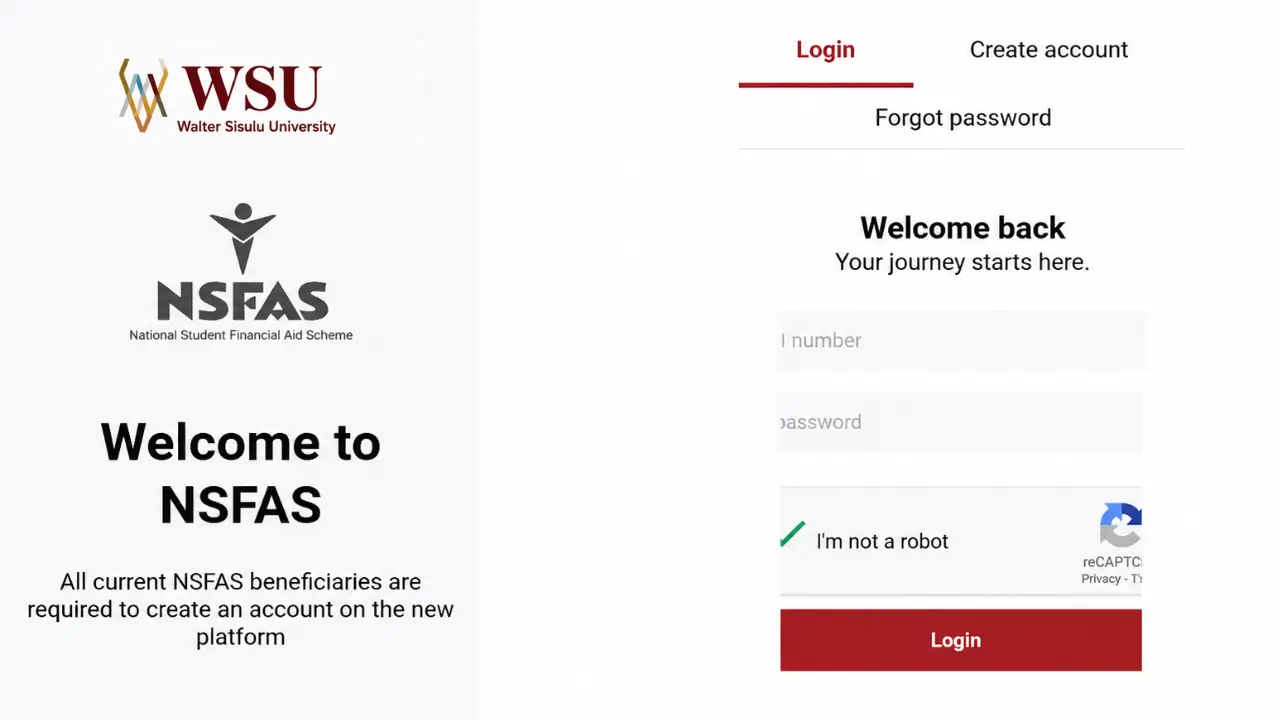
You will receive a One-Time Password (OTP) via SMS or email. Enter it to verify your account. Once verified, your myNSFAS account is active.
Important: Use a cellphone number and email address that you personally own and check regularly. NSFAS sends all updates, OTPs, and funding decisions to the contact details linked to your account. Using a relative’s number or school email creates problems you cannot easily fix later.
Step 2: Log Into Your myNSFAS Account
Go back to www.nsfas.org.za, click “myNSFAS”, and log in with your ID number and password. If you forget your password, click “Forgot Password” A reset link will be sent to your registered email or phone.
Step 3: Complete the Application Form
Once logged in, go to “My Applications” and click “Apply”. Fill in every section carefully:
Note: NSFAS no longer uses the Coinvest wallet or any third-party payment cards. As of February 2024, all allowances are paid directly into your own bank account. If you see any website or person offering a “NSFAS card” or Coinvest account, it is a scam.
Step 4: Upload Your Documents
Upload all required documents in the correct file format. NSFAS accepts PDF and JPG files. Each file must be:
Upload each document against the correct field. Uploading an ID copy in the proof-of-income field is a common error that causes verification delays.
Step 5: Submit and Save Your Reference Number
Once all sections are complete and all documents are uploaded, click Submit. A confirmation message will appear on screen.
You will receive a reference number via SMS and email. Save this immediately. Screenshot it or write it down. You will need it to track your application and resolve any issues.
Step 6: Monitor Your Application Status
Log into your myNSFAS account regularly and check your status under “My Applications.” NSFAS also sends SMS and email notifications when your status changes, but do not rely on these alone. Check the portal directly at least once a week.
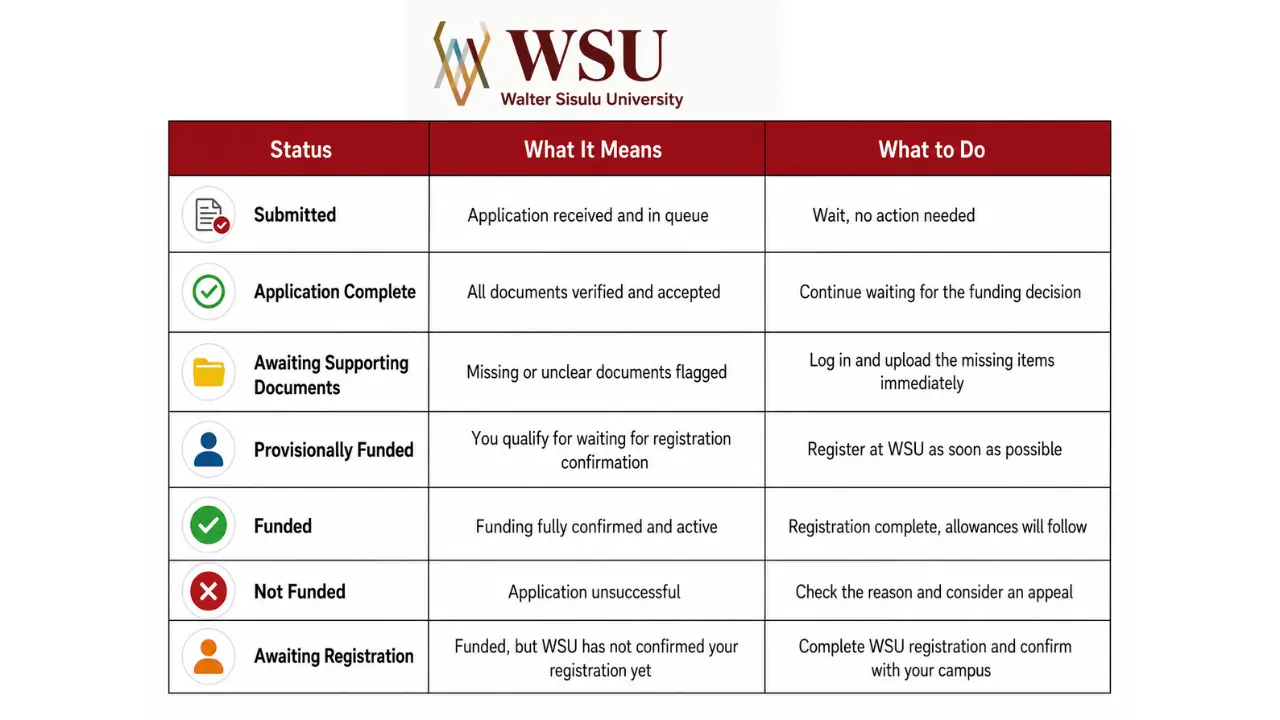
What Each NSFAS Application Status Means
Status | What It Means | What to Do |
|---|---|---|
Submitted | Application received and in queue | Wait, no action needed |
Application Complete | All documents verified and accepted | Continue waiting for the funding decision |
Awaiting Supporting Documents | Missing or unclear documents flagged | Log in and upload the missing items immediately |
Provisionally Funded | You qualify for waiting for registration confirmation | Register at WSU as soon as possible |
Funded | Funding fully confirmed and active | Registration complete, allowances will follow |
Not Funded | Application unsuccessful | Check the reason and consider an appeal |
Awaiting Registration | Funded, but WSU has not confirmed your registration yet | Complete WSU registration and confirm with your campus |
What “Provisionally Funded” Actually Means
Many students see “Provisionally Funded” and assume something is still wrong. It is not. This is a positive status.
Provisional funding means NSFAS has approved your application based on the information submitted. The word “provisional” exists because your funding is only finalised once WSU confirms that you have registered for the 2026 academic year. The moment your registration is uploaded by WSU, your status moves to “Funded”, and allowances begin processing.
If your status stays at “Provisionally Funded” for longer than expected after you have registered, contact WSU’s Financial Aid Office. The delay is usually on the institutional registration upload side, not with NSFAS itself.
WSU NSFAS Allowance Amounts for 2027
For 2027, NSFAS allowances for university students generally include a living allowance of approximately R15,000–R17,160 per year (roughly R1,500–R1,700 per month), plus a personal care allowance and a learning materials allowance. Here is the full breakdown:
Allowance Type | Approximate Annual Amount |
|---|---|
Living Allowance | R15,000–R17,160 |
Personal Care Allowance | R2,900–R3,167 |
Book / Learning Materials | R5,678 |
Accommodation (university residence) | Covered directly |
Tuition Fees | Covered directly — paid to WSU |
Disability Support (human support) | Up to R52,000 |
Assistive Devices (disability) | Up to R54,080 |
Exact 2026 allowance figures may vary slightly across sources. The authoritative number is in the NSFAS Bursary Guidelines PDF available on nsfas.org.za.
Allowances are released from February each year, after WSU confirms your registration with NSFAS. If your status shows “Awaiting Registration,” payments will not process until the registration upload is accepted by NSFAS.
What Happens if Your WSU NSFAS Application Is Rejected?
Of the 893,847 applications processed for 2026, 49,568 were rejected. You have 30 calendar days from the date your rejection appears on the portal to submit an appeal.
The most common rejection reasons include:
How to Appeal a Rejected NSFAS Application
Appeals are reviewed by NSFAS, and outcomes are communicated through your myNSFAS account. If your appeal is successful, your application moves back into the funding pipeline.
WSU NSFAS Application: Example Scenario
Consider a matric student from Mthatha whose mother works as a domestic worker earning R3,500 per month. Their combined household income is well below R350,000 annually. She applies to WSU’s Faculty of Education and submits her NSFAS application in October 2026, well before the 15 November deadline.
By December 2026, her myNSFAS portal shows “Provisionally Funded.” She registers at WSU’s Mthatha campus in January 2027. Once WSU uploads her registration confirmation, her status changes to “Funded.” From February, her living and book allowances begin arriving in her bank account monthly, and her tuition is settled directly between NSFAS and WSU.
She does not pay a cent upfront. As long as she maintains satisfactory academic performance, the funding continues throughout her qualification.
Common Mistakes That Get WSU NSFAS Applications Rejected
Using someone else’s contact details: NSFAS links all updates and OTPs to the details on your account. If you use a relative’s phone number or email, you may miss critical notifications, including document upload requests that have short response windows.
Uploading blurry document photos: Blurry or low-quality uploads are flagged during verification. Use a scanning app and check each upload before submitting.
Applying too close to the deadline: The myNSFAS portal gets extremely slow in the final week before the closing date. Apply at least two weeks early to avoid technical issues.
Not checking the portal regularly: NSFAS may request additional documents after you submit. If you do not respond within the given window, your application is paused. Check your portal at least once a week throughout the process.
Submitting incorrect banking details: Allowances go directly to your bank account. If your account number or branch code is wrong, payments are delayed or rejected. Double-check every digit before saving your banking details.
WSU Financial Aid and Bursary Alternatives
If you do not qualify for NSFAS, other funding options are available:
WSU Institutional Bursaries: WSU offers merit-based and need-based bursaries through its own Financial Aid Office. These are separate from NSFAS and have their own application process. Contact the Financial Aid Office at your specific campus for current availability.
Fundi Student Loans: Fundi offers private student loan options for South African students who do not qualify for NSFAS. These are repaid after you enter employment. Compare terms carefully before committing.
Sector Education and Training Authorities (SETAs): Various SETAs offer bursaries for students studying in specific fields — engineering, health, education, and others. These are worth researching based on your chosen programme at WSU.
WSU Campus Financial Aid Contacts
If you need help with your WSU NSFAS application or have questions about your funding status, contact the Financial Aid Office at your campus:
Mthatha Campus (Main)
- Email: [email protected]
- Phone: 047 502 2448
Butterworth Campus
- Email: [email protected]
- Phone: 047 401 6048
Buffalo City Campus (East London)
- Email: [email protected]
- Phone: 043 709 4039
Komani Campus (Queenstown)
- Email: [email protected]
- Phone: 040 842 6806
Always include your full name, ID number, and myNSFAS reference number in any email.
FAQs About WSU NSFAS Application
Conclusion
The WSU NSFAS application is one of the most important steps you will take as a prospective Walter Sisulu University student. It determines whether your fees are covered, whether you can afford accommodation, and whether you can focus on your studies without financial pressure.
But NSFAS does not come to you; you have to apply on time, with the right documents, through the official myNSFAS portal. Apply for NSFAS and WSU admission at the same time. Do not wait for one before starting the other.
If your application comes back as “Provisionally Funded,” register at WSU immediately. The faster WSU confirms your registration, the faster your allowances start moving. And if your application is rejected, you have 30 days to appeal; use that window.
Your financial future at WSU is worth the 30 minutes it takes to complete this application correctly.
Apply for NSFAS funding: www.nsfas.org.za Apply to WSU: www.wsu.ac.za Check your NSFAS status: my.nsfas.org.za
NSFAS does not accept late applications. The 2026 window has closed. If you missed it, apply early in September 2026 for the 2027 academic year and start preparing your documents now.
Thobeka Nkosi 
I am Thobeka Nkosi, a content writer at wsuonlineapplication.co.za. I write simple, helpful guides on South African university applications, student portals, and admissions processes to help students understand and complete their academic steps without confusion.